2025-2026 Timber-Strong Design Build

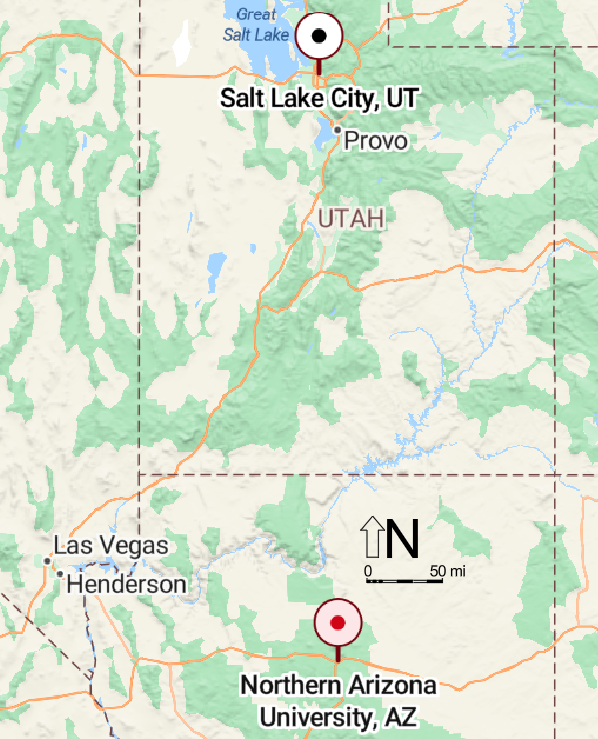
The 2026 ISWSS Competition will take place at the University of Utah, located in Salt Lake City, UT. Since the inception of this competition, rules and guidelines have been updated each year to introduce novel challenges to the design team. 

The phases of the project, including framing plan design, structural calculations, Building Information Model (BIM) creation, and construction drawing preparation will take place within the Engineering Building at Northern Arizona University (NAU). The 2018 National Design Specification for Wood (NDS) and the 2021 Special Design Provisions for Wind and Seismic (SDPWS) will be the primary standards guiding the design process. Building design requires an understanding of the load path, competition loading requirements, geometric criteria, sustainable design, and the prefabrication and construction processes.

Project 
Location
Project 
Constraints
Project 
Tasks
Gantt Chart Staffing 
Matrix
Cost of 
Services

Project Location

The final build day will be held at the ISWSS Competition at the University of Utah, located in Salt Lake City

April 16 - 17, 2026
201 President's Circle 
Salt Lake City, UT 84112

Project Constraints

The Timber-Strong Design Build team is placed under multiple design and time constraints. This covers first- and second-floor dimensions, window spacing and placement, cantilever beam deflection, and the 90-minute construction time limit during the competition. Further constraint details are listed in the Timber-Strong Design Build 2026 Rules.

Project Tasks

Task 1: Research

The purpose of this task is to obtain information for the competition requirements, provided in the Timber-Strong Design Build 2026 Rules. This task involves becoming familiar with typical light-wood framing methods for gravity and lateral loads. 

T
ask 1.1:Research Past Competition Teams
Task 1.2:
Research Competition Rules
Task 1.3: Research Structural Systems
Task 1.4: Research Material Availability

Task 2: Design Selection

The purpose of this task is to brainstorm various structural systems and identify/select which design will be the most suitable per the competition rules.

Task 2.1: Brainstorm Structural Systems
Task 2.2: Identify Viable Design Options
Task 2.3:
Select Design

Task 3: Final Structural Analysis & Design

The purpose of this task is to draft a detailed framing plan of the selected design. This framing plan includes gravity, diaphragm, shear wall, uplift connection, tiedown, anchor, and cantilever beam design.

Task 3.1: Draft Framing Plan
Task 3.2: Gravity Design
Task 3.3: Diaphragm Design
Task 3.4: Shear Wall Design
Task 3.5: Uplift Connection Design
Task 3.6: Tiedown and Anchor Design
Task 3.7: Cantilever Beam Design
Task 3.8: Final Calculation Packet
Task 3.9: Final Structural Drawings
Task 3.10:
Building Information Model

Task 4: Pre-Competition Construction Phase

The purpose of this task is to secure material from our sponsors for the competition and complete mock competition construction practices. This task also involves the prefabrication of materials to ensure that all parts of the structure are ready for the competition. 

Task 4.1: Material Procurement Phase
Task 4.2: Prefabrication Phase
Task 4.3: Mock Assembly and Practice
Task 4.4: Transportation Preparation

Task 5: Competition Construction Process

The purpose of this task is to compete in the ASCE 2026 Timber-Strong Design Build Competition and maximize the chances of winning by following the step-by-step process of the 90-minute construction time. 

Task 5.1:
90-Minute Competition Construction Process
Task 5.2:
Deconstruction Phase 

Task 6: Impact Assessment

The purpose of this task is to analyze our final design impact on the environment, as well as its effectiveness and cost-efficiency.

Task 6.1: Carbon Footprint Calculation
Task 6.2:
Triple Bottom Line Assessment

Task 7: Deliverables

The purpose of this task is to complete and submit all of the required deliverables for the competition and our capstone course (CENE 486C). Competition deliverables are submitted through the ASCE Cerberus portal.

Task 7.1: Competition Deliverables
Task 7.2: Capstone Deliverables

Task 8: Project Management

The purpose of this task is to ensure efficient and professional teamwork will be accomplished through meetings, communication, funding management, etc.

Task 8.1: Team Coordination
Task 8.2: Outreach and Volunteers
Task 8.3: Safety Oversight and Training
Task 8.4: Quality Control and Compliance

Gantt Chart

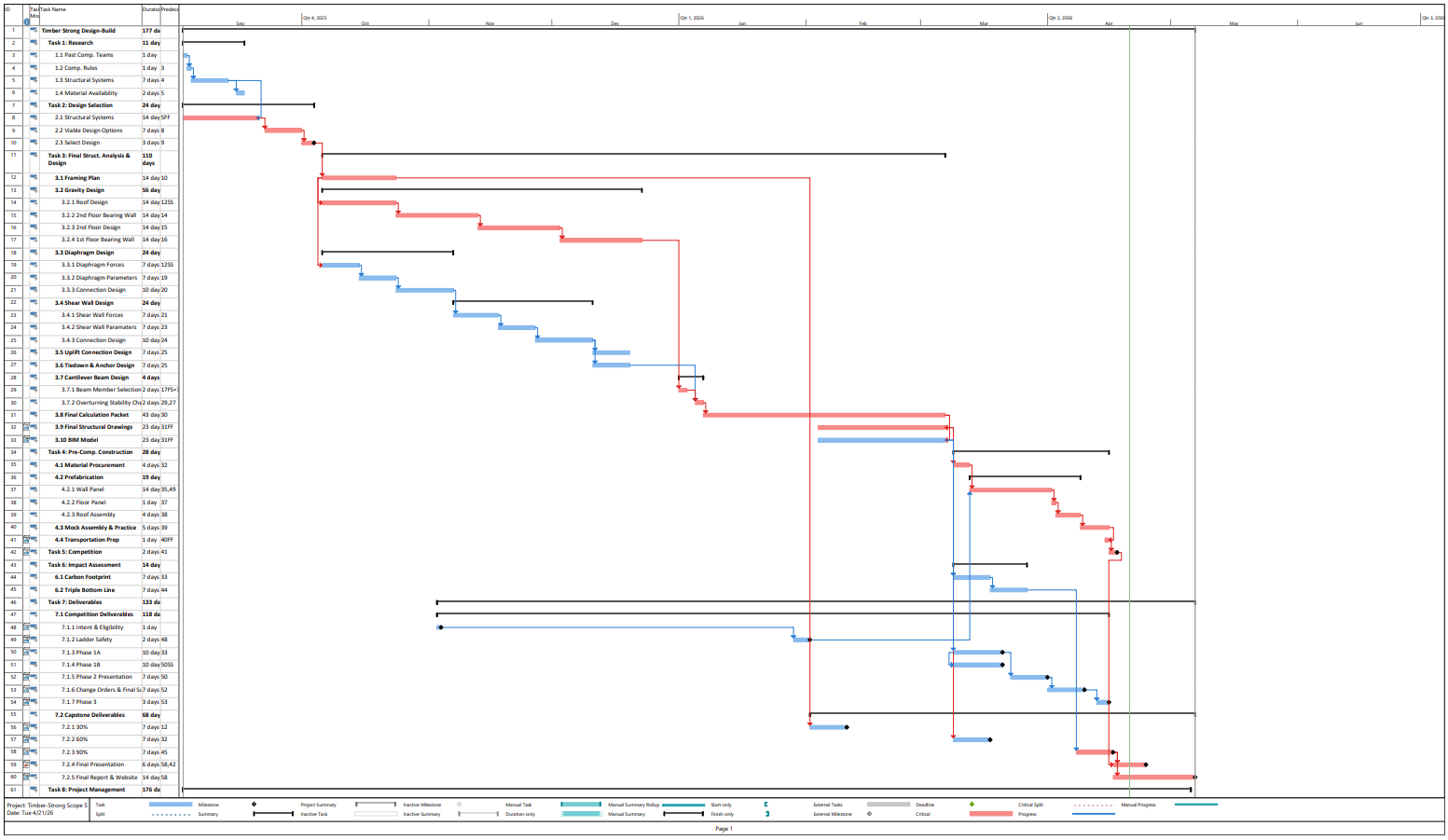
Sky High Structures created a Gantt Chart, which includes the start date and scheduling of every task. Each task is assigned a duration and dependencies to automatically generate and project schedule and critical path. The start date of the entire project was September 2, 2025 and the project is projected to be complete on May 5, 2026. ​The project will have a total duration of 176 days.

Link to Gantt Chart PDF

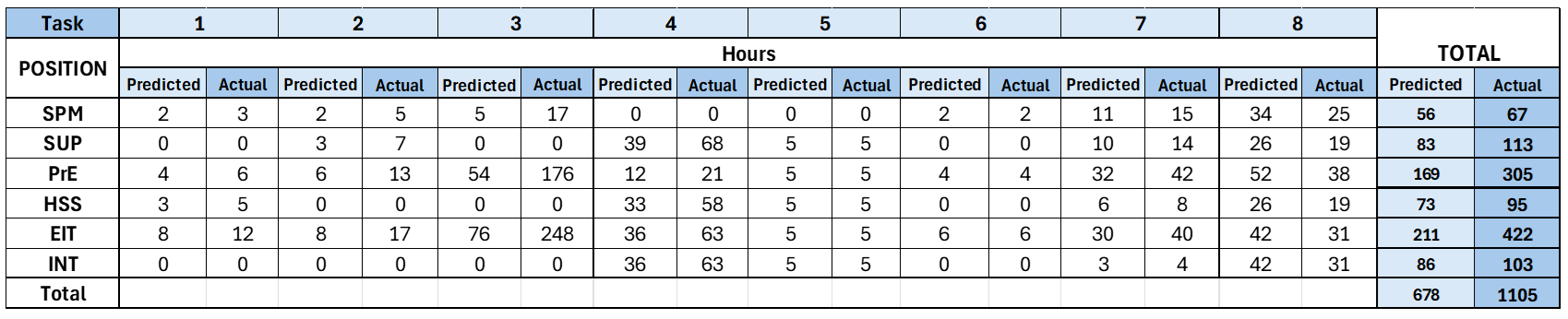
Staffing Matrix

SPM: Senior Project Manager
SUP: Superintendent
PrE: Project Engineer
HSS: Health & Safety Specialist
EIT: Engineer in Training
INT: Construction Intern

Link to full Staffing Matrix

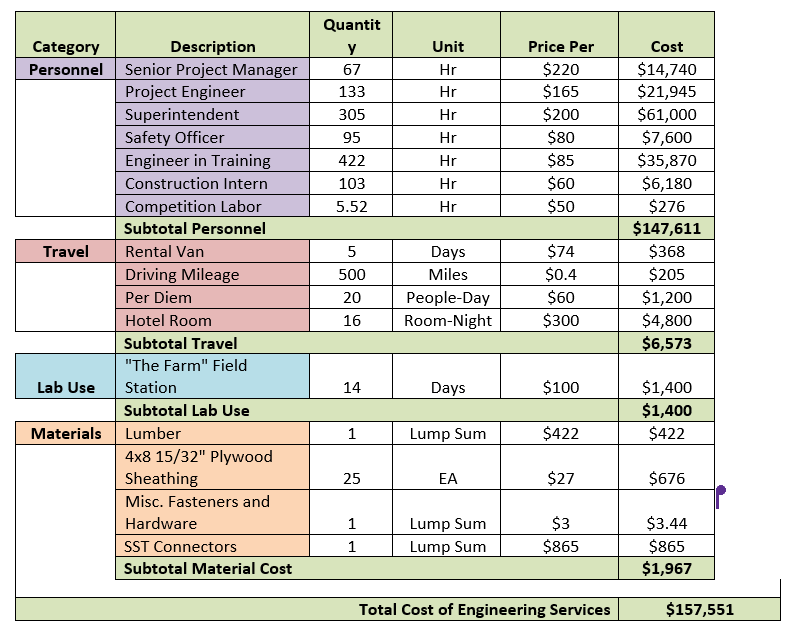
Cost of Engineering Services

Sky High Structures has prepared an estimate for the total cost of engineering services for the proposed project, which is shown in the table below. This table summarizes the estimated billable hours for each staff member, billable rates, and total cost. More information for the cost can be found in Section 5 in the Final Proposal