|
2009 - 2010 SAE Mini Baja |
|
Northern Arizona University |


|
Suspension |


|
For an off-road vehicle to work properly, the suspension system must allow the vehicle to maneuver over rugged terrain and keep the wheels on the ground at all times. To achieve this, the suspension was designed using the following key constraints: rigid structure, large amount of wheel travel, sufficient ground clearance, and correct Ackerman steering with minimal bump steer. Front Suspension There are several front suspension designs to choose from including variations of solid axle and independent front suspension systems. Solid axle suspensions are strong, but are also very heavy and react poorly to changes in terrain. An independent front suspension allows both wheels to follow the contour of the terrain independently of each other, resulting in a smoother, more stable ride, and better handling. The independent front suspension system gives the engineer the ability to tailor the suspension design to the vehicle. Cornering stability, suspension travel, caster, and camber curves can all be configured to suit the application. The independent suspension system selected a J-arm design. As shown in Figure 7, the J-arm design is the same as a double A-arm design except that it utilizes a J-shaped upper control arm mounted in front of the spindle rather than an A-shaped upper control arm mounted directly above the spindle. Mounting the upper control arm in front of the spindle creates clearance for the shock absorber/spring to pass through the area behind the control arm. This makes for neater packaging and allows the shock to be easily adjusted while on the vehicle.
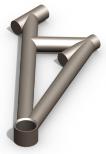
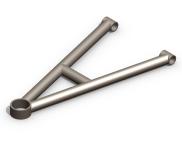
Figure 7: The J-arm is shown on the left, compared to the A-arm shown on the right. Rear Suspension In a rear wheel drive off road vehicle, the rear suspension system must keep the tires on the ground over varying terrain to provide traction. The vehicle’s drivetrain design dictated that the rear suspension be of the independent type. This limited design options to dual a-arms or a trailing arm system. A trailing arm system allows the tire to roll over the bump, where a double a-arm system actually skips over it. The trailing arm system chosen will provide a large amount of wheel travel, better traction, and be lighter in weight than a double a-arm design. Design The front and rear suspension systems are a combination of self-fabricated and purchased products from outside sources. The following specifications were desired for the suspension systems: Front suspension travel: 10 in Rear suspension travel: 14 in Vehicle ride height: 12 in Front track width: 58 in Rear track width: 63 in
The control arms are made from 1.25" x 0.095 wall 4130 chromemoly tube stock. The front A-arms use threaded bungs and heim joints at the inner pivots and uniball bearings to mount to the steering knuckle. The rear trailing arms are made from 1.25" x 0.120 wall 4130 chromemoly tube stock The front control arms, steering knuckles, and the rear trailing arms were fabricated in our shop in order to achieve the proper suspension geometry. The suspension components are attached to the frame with custom tabs manufactured in house and purchased from Ballistic Fabrication in Tucson, AZ. Suspension parts from Polaris ATV’s were used in both the front and rear suspension designs. The front suspension utilizes the hubs, bearings, and spindles from a 2006 Predator 500 ATV. The rear suspension uses hubs, bearings, and drive flanges from a 2006 Hawkeye ATV. The design also utilizes nitrogen charged air shocks the front and the rear. Air shocks are much lighter than a coilover shock and provide a progressive valving to absorb the energy of the wheels. The front and rear suspension utilize Fox Racing ShoxÔ 2.0 air shocks with 25.4 cm (8 in) and 30.5 cm (12 in) of travel respectively. |